Yoga for Holiday Anxiety: Breathing Practices to Help You Sleep and Stay Steady
The Philippines celebrates the longest Christmas season in the world. It starts in September and runs well into January. For many of us, that also means the longest stretch of stress.
There are gifts to buy, reunions to attend, bills that land all at once, and for some, an empty seat at the table. Last holiday season, the Department of Health's mental health hotline took 961 calls in the two weeks between December 21 and January 2. Anxiety was one of the most common reasons people called.
If you feel more on edge this time of year, you are not alone. And there are small things you can do for yourself every day.
What yoga can and can't do for anxiety
Let's be clear first. Yoga is not a replacement for a doctor, a therapist or medication. If you are in treatment, keep going, and talk to your doctor before changing anything.
What yoga can offer is support alongside that care. A 2018 review of randomized controlled trials found that yoga may help people who are experiencing elevated anxiety. The researchers also noted that more studies are needed for diagnosed anxiety disorders.
In the tradition we teach at Indian Yoga School PH, yoga was never only about the body. Asana, breath, meditation and philosophy are one practice. When the mind is anxious, the breath is usually the first thing to change. It is also the first thing we can learn to change back.
Why sleep matters so much in the holidays
Late nights, travel, heavier meals and a broken routine all affect sleep. Poor sleep then makes stress harder to handle the next day, and the cycle continues.
Anna (not her real name), 38, knows this well. She was prescribed medication for sleep as part of her mental health treatment. After a few sessions with us, she noticed she slept better on the nights she had class.
"I used to take my sleep medication every night. After a few yoga sessions, I noticed I slept better after each class. Yoga is the only thing I added to my routine, and now I look forward to every class, whether it's gentle yoga with Teacher Anj or a more challenging class with Teacher Kirti."
Every person is different, and her experience is her own. But it shows what a steady, daily practice can add to your evenings.
From night shift to steady sleep
Chi, 33, has struggled with sleep since childhood. She worked the night shift for 15 years, from 2011 until early 2026. When she moved to a day schedule in January, her body clock didn't come with her. Four hours of sleep was a good night. Some nights, there was none at all.
In July, she joined our 100-hour Hatha Yoga Teacher Training, not to fix her sleep but because she loves teaching and fitness. She has never taken sleep medication, and she tracks her sleep with a watch.
During her training month, she went without sleep on about half her nights. One stretch of three sleepless nights left her with a fever from exhaustion, and she caught up with crash sleeps of 10 to 14 hours. By August, she was sleeping on nearly every night, between about four and eight hours, usually falling asleep around 1 AM and waking around 8 AM.
"I've struggled with sleep since I was a child. Night shift felt like the obvious choice, because sleeping when you're dead tired sounds easier. But I'd wake up after two or three hours and couldn't fall back asleep. Even after I switched to days, I couldn't find my rhythm, and I thought that was just how my sleep was. I didn't realize the breathwork, the meditation and the calm were what my body needed. I didn't see it at first, until I noticed my sleep tracking slowly changing."
Notice what changed. She isn't sleeping more hours on average. Her sleep became regular, and for anyone coming off years of night shift, that steadiness is the hard part.
Three practices to try tonight
These are gentle and suitable for beginners. Practice on an empty or light stomach, breathe through the nose, and stop if you feel dizzy or uncomfortable.
1. Long exhale breathing (3 to 5 minutes)
Sit or lie down comfortably and close your eyes.
Breathe in through your nose for a count of 4.
Breathe out slowly through your nose for a count of 6 to 8.
Keep the breath smooth. Never force it.
A longer exhale tells your body it is safe to slow down. This is a good practice to use in the moment, even in traffic or before a family gathering.
2. Nadi Shodhana, or alternate nostril breathing (5 minutes)
Sit tall. Rest your left hand on your knee.
Close your right nostril with your right thumb and breathe in through the left.
Close the left nostril with your ring finger, release the thumb, and breathe out through the right.
Breathe in through the right, switch, and breathe out through the left. That is one round.
This is one of the most traditional pranayama practices. Many students find it settles a busy mind before meditation or sleep.
3. Viparita Karani, or legs up the wall (5 to 10 minutes)
Sit sideways next to a wall, then swing your legs up as you lie back.
Rest your arms by your sides, palms up.
Let your breath slow down naturally.
This restorative pose is easy to do in bed before sleep. Skip it if you have glaucoma, uncontrolled high blood pressure or are in late pregnancy, and ask your doctor if you are unsure.
Practice with us
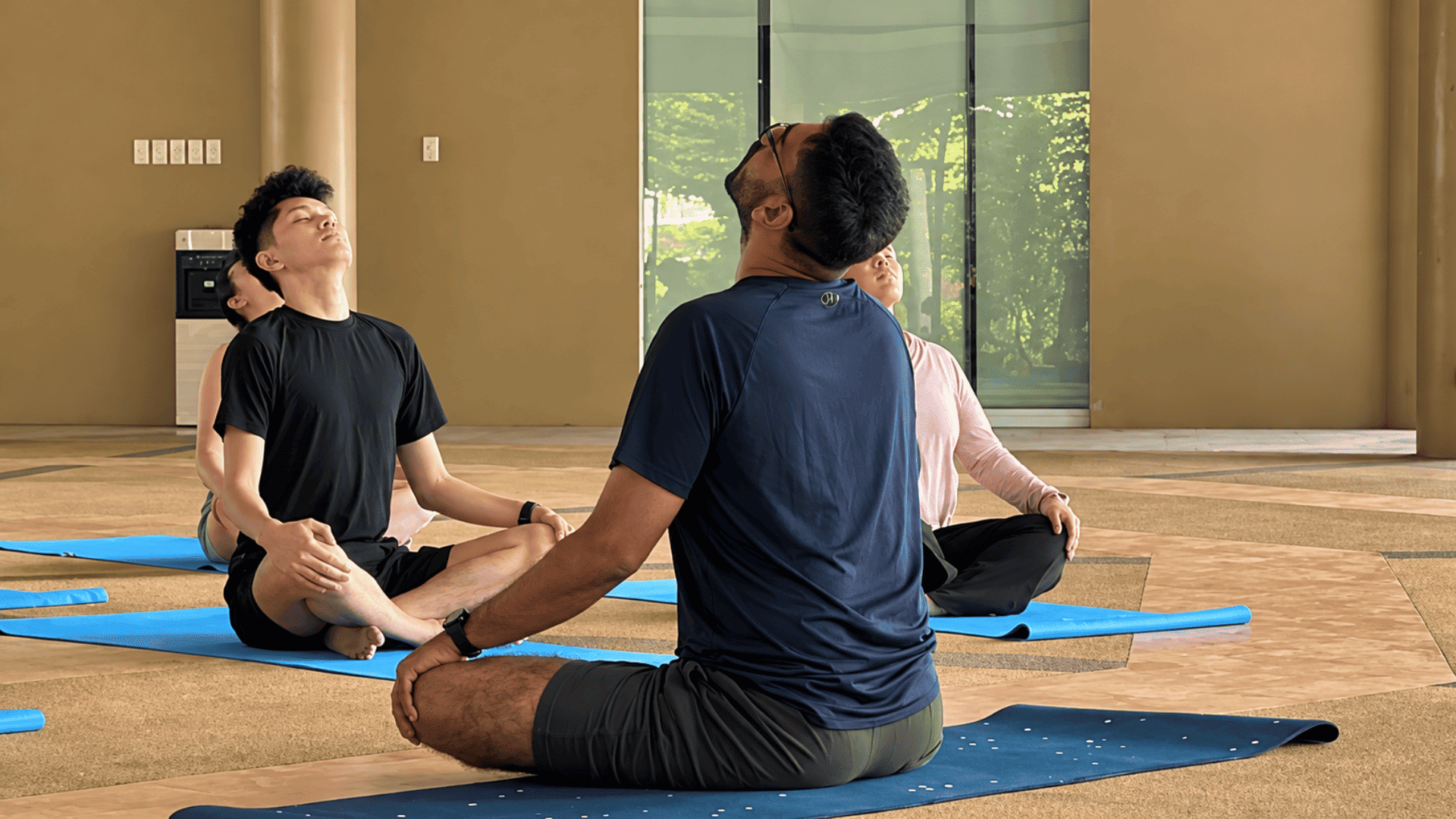
Reading about breath is a start. Practicing with a teacher is where it changes. Every Hatha Vinyasa class at our studio in Taytay, Rizal includes pranayama and meditation alongside the physical practice, so the tools in this article are part of every session.
Classes are led by Yogi Kirti Anand Ji, who taught for more than 10 years at yoga schools in Rishikesh, India. Every class welcomes complete beginners. You don't need to be flexible. You just need a reason.
If you need help now
If you are struggling, please reach out. The NCMH Crisis Hotline is open 24/7: 1553 (toll-free nationwide landline), 0919-057-1553 or 0917-899-8727.
About Indian Yoga School PH
Indian Yoga School PH is a yoga school in the Philippines dedicated to making traditional yoga practice accessible across ages, backgrounds, and experience levels. The school offers guided yoga classes, workshops, retreats, and yoga teacher training programs designed to support physical movement, mindfulness, personal development, and lifelong practice.
